Travel Guide to Azerbaijan 2026: Top 25 places anywhere (Travel guide to the world 2026 Book 4)
Product Description
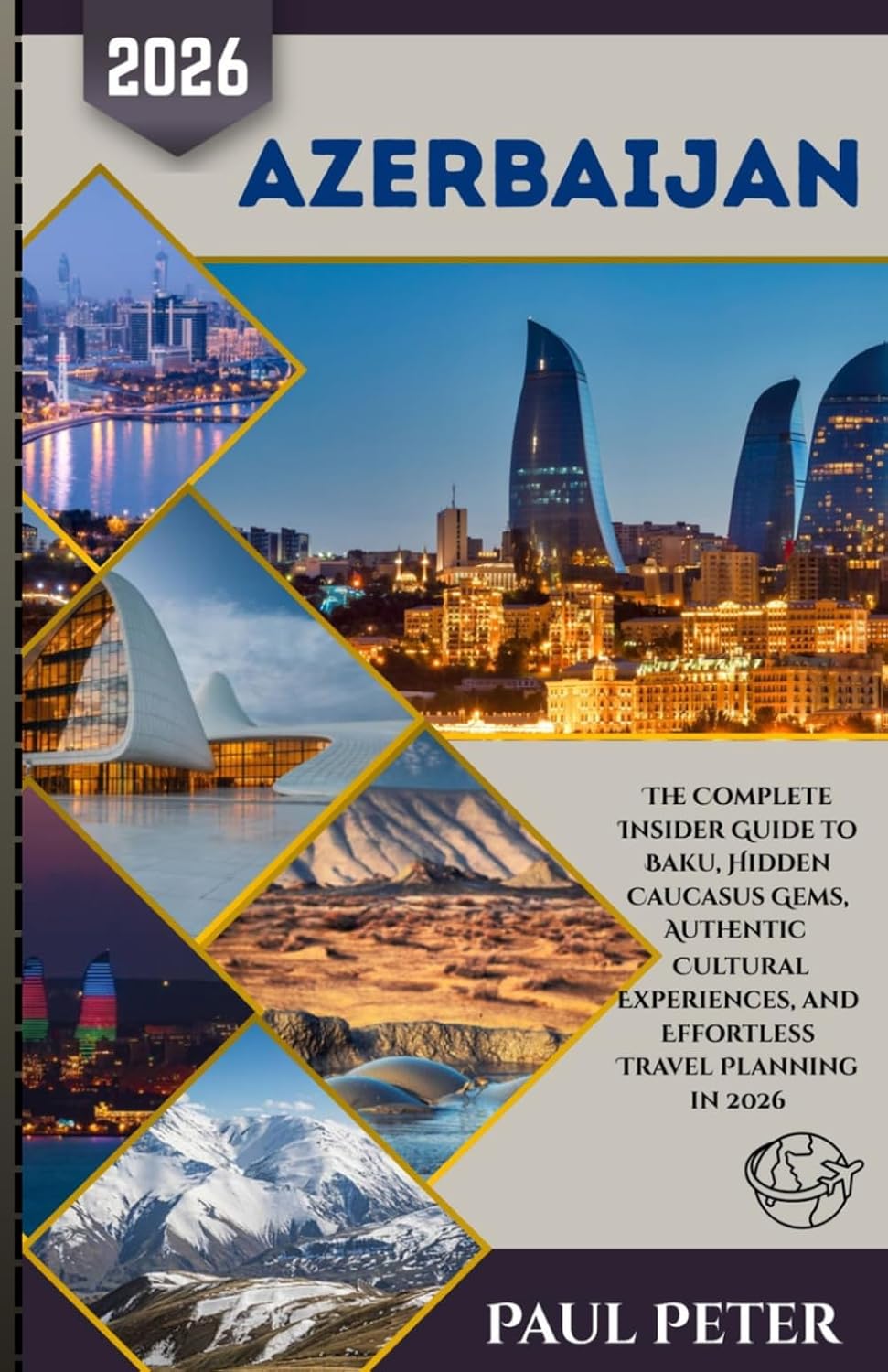
Azerbaijan is the kind of place that doesn’t just sit quietly in the corner—it hums with energy, flickers with light, and occasionally surprises you with how many layers it’s carrying at once. Straddling Eastern Europe and Western Asia, Azerbaijan feels like a meeting point rather than a boundary. Its landscapes shift quickly and without apology—mud volcanoes bubbling like the earth is thinking out loud, the windswept shores of the Caspian, and mountains that rise in the distance as if to remind you that nature here prefers variety over consistency. It’s not dramatic in a single tone; it’s a whole orchestra warming up.History here doesn’t whisper—it overlaps. Influences from Persian, Turkic, Russian, and Islamic worlds don’t compete so much as coexist, sometimes awkwardly, often beautifully. Ancient caravan routes once passed through this land, and you still get the sense that movement—of people, ideas, and cultures—never really stopped. The past isn’t frozen; it’s layered, like a city built on its own memories.The capital, Baku, is where all these contrasts become visible at once. The medieval walls of Icherisheher stand calmly beside the futuristic curves of the Flame Towers, as if time decided not to argue with itself. Oil wealth has given the city a polished edge, but step into the old quarters and you’ll find narrow alleys that seem to resist modernization out of principle.Food in Azerbaijan feels like an invitation you didn’t realize you’d accepted. Dishes arrive generously, often built around rice, herbs, and slow-cooked meats, with flavors that reflect centuries of exchange along the Silk Road. Meals stretch, conversations deepen, and hospitality becomes less of a gesture and more of a quiet expectation.Azerbaijan doesn’t try to resolve its contrasts—it leans into them. It’s modern without fully letting go of its past, traditional without being frozen in it. Its charm lies in that balance, in the way it allows different identities to exist side by side without insisting they match. It’s a place that doesn’t ask to be understood immediately—it just asks you to stay long enough for it to make sense. earned, stories feel lived-in, and every stone, street, and smile seems to say: we’ve been here a long time—and we’re not going anywhere.Azerbaijan is divided administratively and geographically in a few distinct ways. Understanding this structure helps make sense of how the country is governed and how its regions differ.1. Primary Administrative DivisionsAzerbaijan is mainly divided into:Rayons (Districts) – These are the main administrative units (similar to districts in India). There are around 60+ rayons, each with its own local administration.Cities (Independent Cities) – Some major cities are administratively separate from rayons. The most important is Baku, which functions as a separate administrative unit.2. Autonomous RepublicNakhchivan Autonomous Republic: This is a special self-governing region of Azerbaijan. It is geographically separated from the main part of the country (an exclave), bordered by Armenia, Iran, and Turkey. It has its own parliament and constitution but is still part of Azerbaijan..3. Economic RegionsFor planning and development, Azerbaijan is also divided into economic regions (about 10–14, depending on classification). These group multiple districts together based on geography and economy—for example:Absheron region (around Baku)Ganja-Gazakh regionSheki-Zagatala regionThese are not political divisions but are used for development and statistical purposes.4. Special/Disputed RegionNagorno-KarabakhThis region has been a major point of conflict between Azerbaijan and Armenia. Safe travel in Azerbaijan! Read more