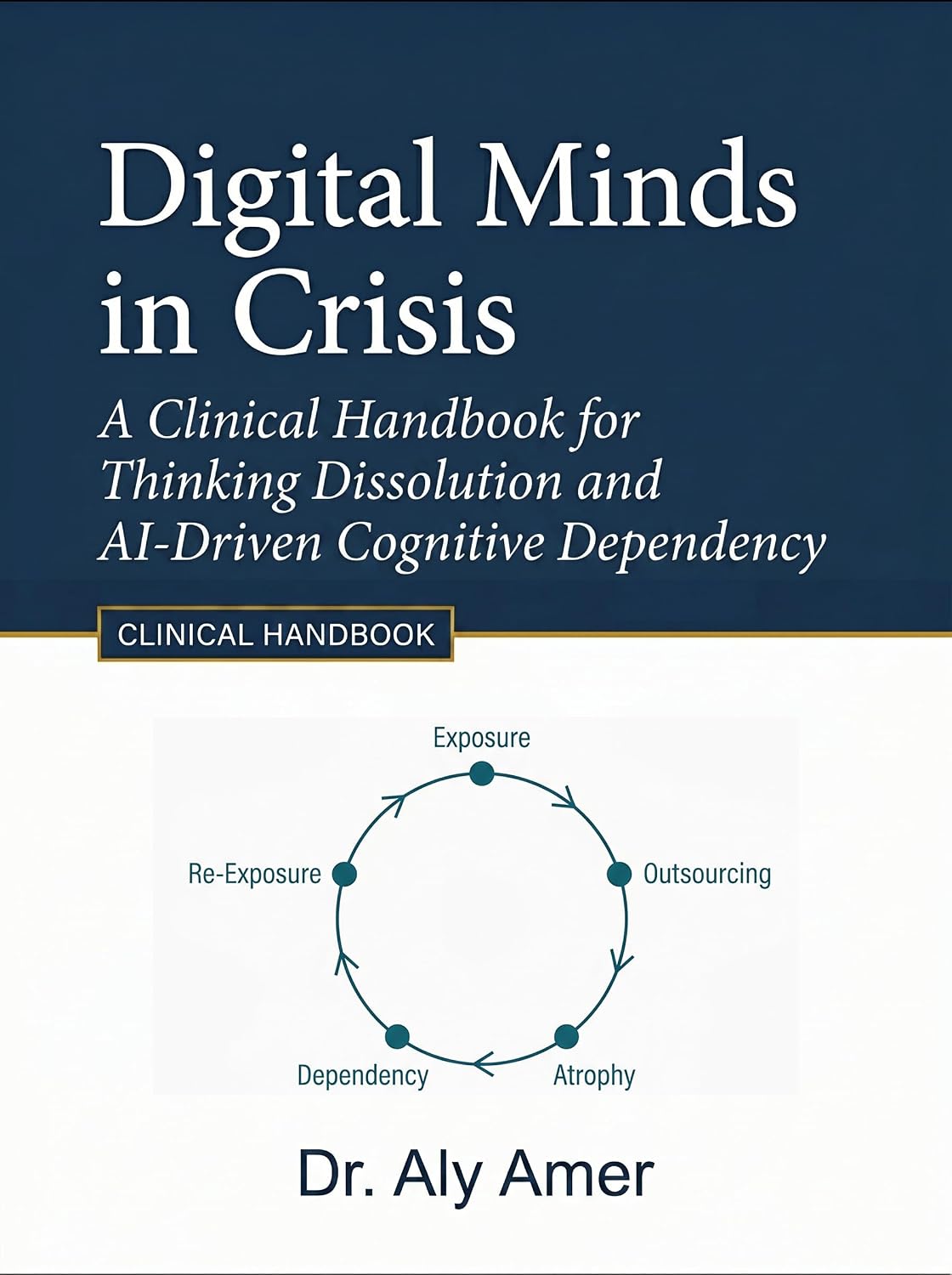
Digital Minds in Crisis: A Clinical Handbook for Thinking Dissolution and AI-Driven Cognitive Dependency
Product Description
Your clients' minds are changing. Here is the clinical framework to understand why — and the evidence-based tools to intervene.In consulting rooms, school counseling offices, and hospital wards around the world, practitioners are encountering a presentation that existing diagnostic frameworks do not fully capture: clients who are intelligent, motivated, and functionally impaired — not by mood disorder, not by neurodevelopmental difference, but by a progressive erosion of the cognitive independence that once defined their functioning. They cannot sustain reasoning without AI assistance. They cannot tolerate the ambiguity that deep thinking requires. They have outsourced their cognition so completely that unassisted thought has become genuinely aversive. This is Thinking Dissolution — and this volume is the first comprehensive clinical handbook designed to address it.For practitioners who are ready to name what they are seeing and respond with evidence-based precision, this handbook provides:The Thinking Dissolution Cycle — a five-stage clinical model (Exposure → Outsourcing → Atrophy → Dependency → Re-exposure) with stage-specific assessment indicators, neurobiological grounding, and intervention entry points for each stageThe Thinking Dissolution Screening Index (TDSI) — a 16-item, four-domain screening instrument integrating behavioral dependency, cognitive outsourcing, metacognitive awareness, and emotional regulation into a single clinically actionable screen with severity thresholds and domain-level subscore interpretationEvidence-based intervention protocols — including CBT-IA (Cognitive Behavioral Therapy for Internet/AI Addiction), MBCT-adapted attentional training, phased digital detox with reintegration protocols, and family systems approaches — organized by Thinking Dissolution Cycle stage and functional presentationThree fully developed clinical case studies — Maya (adolescent, academic), James (young adult, occupational), Liam (early childhood, family) — presented with complete 4P formulations, session-by-session progression data, TDSI score trajectories, and six-month follow-up outcomesTen structured tables covering core signs and symptoms, age-related vulnerabilities, cognitive effects, stakeholder responsibilities, intervention comparisons, assessment instruments, implementation checklists, case analyses, research roadmaps, and the Implementation Science Matrix — all designed for standalone clinical useAssessment framework integrating the IAT, SAS, COQ, MADUS, and TDSI with neuropsychological testing protocols and ecological momentary assessment guidance for comprehensive multi-method evaluationContext-specific implementation guidance for six stakeholder groups: mental health practitioners, school counselors and educators, higher education faculty, healthcare providers, technology designers, and policymakersThis handbook is written for: Clinical psychologists, licensed counselors and social workers, school psychologists, psychiatrists, and counseling educators who encounter digital dependency and cognitive attenuation in their caseloads and require a comprehensive, evidence-grounded professional reference — not a self-help guide, not a parenting manual, but a clinical tool built to the standard of practice.The evidence base integrates findings from neuroimaging, cognitive psychology, developmental neuroscience, behavioral addiction research, and educational psychology, citing more than 70 peer-reviewed sources. The Thinking Dissolution construct is theoretically grounded, clinically operationalized, and empirically supported — positioned to become the standard clinical framework for this emerging and rapidly growing area of practice.This handbook shows practitioners how to make that recovery possible. Read more


