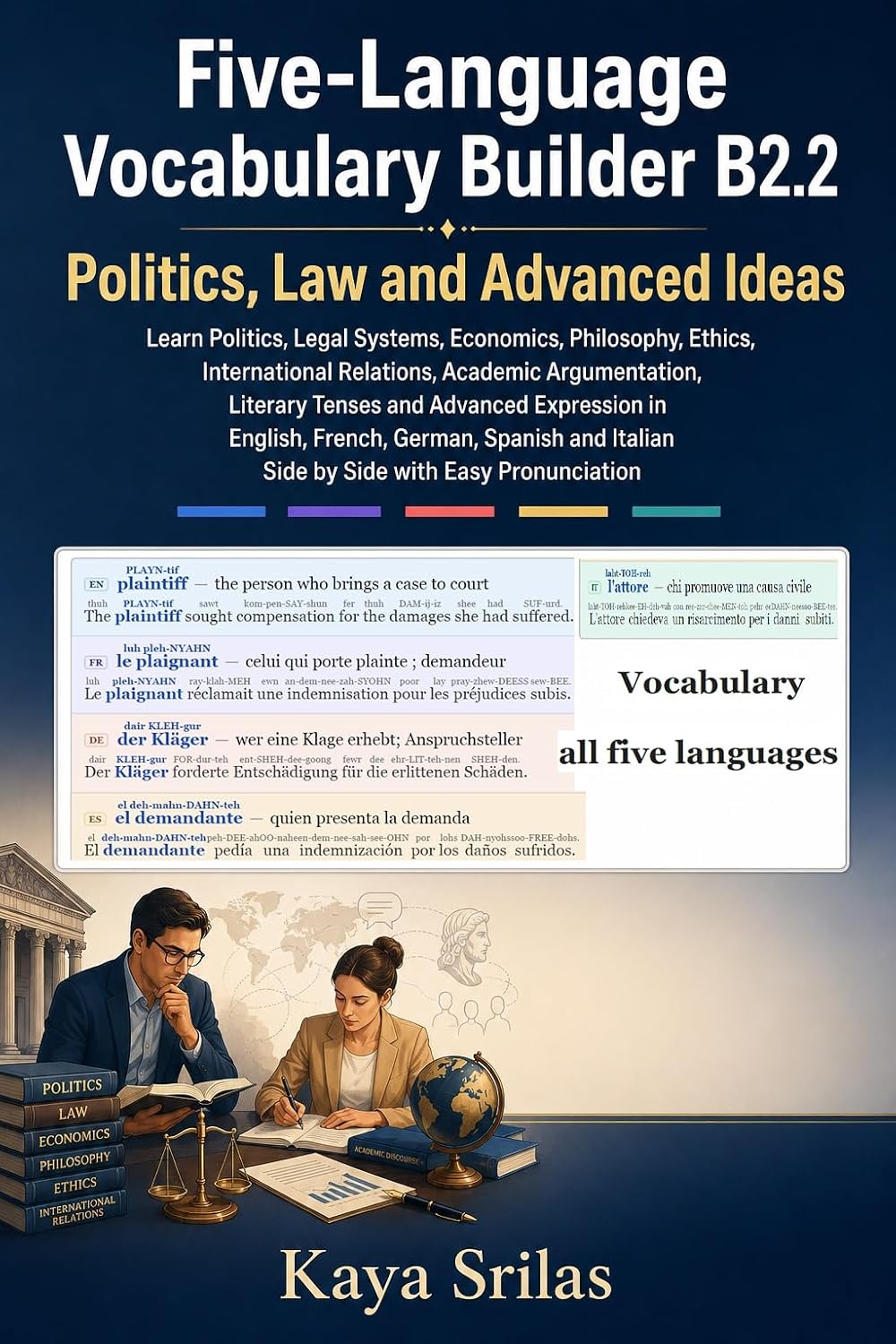
Five-Language Vocabulary Builder B2.2 — Politics, Law and Advanced Ideas: Learn Politics, Legal Systems, Economics, Philosophy & Ethics in English, French, ... Spanish & Italian with Pronunciation
Product Description
Move Beyond Everyday VocabularyExplore politics, law, economics, philosophy, ethics and academic discourse in five languages—side by side.Five-Language Vocabulary Builder B2.2: Politics, Law and Advanced Ideas helps learners ready to discuss complex ideas in English, French, German, Spanish and Italian.Continue from Book 8 or begin here with advanced skills. Develop specialised vocabulary, nuanced argumentation, formal expression and literary tenses that distinguish advanced writing from everyday speech.Five Languages. One Concept at a Time.Every concept follows the same order: EN English, FR French, DE German, ES Spanish and IT Italian.English acts as the anchor. Each language includes easy-English pronunciation, a same-language definition and a natural example sentence, helping you compare words and grammatical contrasts without losing your place.What You Will StudyPolitical systems, governance and the rule of lawCivil, criminal, constitutional and international lawJudicial procedures, evidence, verdicts and appealsMacroeconomics, financial markets and regulationPhilosophy, truth, reason, free will, ethics and moralityDiplomacy, international relations and negotiationAcademic writing, oral expression and advanced argumentationThe Literary Past Across Five LanguagesBook 9 shows how the same one-word past tense has a different status in each language.French: the passé simple is mainly literary and learned for recognition.Spanish: the pretérito is ordinary everyday speech.Italian: the passato remoto may be literary or regional.German: the Präteritum is the standard written past.English: the simple past is natural in speech and writing.You will also meet the anterior past, background-versus-event narration, advanced connectors, near-synonyms and idioms matched by meaning.Pronunciation Without Technical PhoneticsThe interlinear line shows pronunciation, not translation. Easy-English respellings appear above words and natural speech groups, offering a practical starting point without IPA.Meaning comes from the aligned concept, English anchor and same-language definition. Native audio remains valuable for refinement.Inside This B2.2 / C1-Transition VolumeAcross 20 structured chapters, you will encounter 266 concepts expressed as 1,330 language entries, supported by pronunciation guidance, definitions and examples.Chapters include vocabulary groups, readings, role plays, grammar spotlights, exercises and answer keys. Examples are generally 14–22 words long, supporting advanced discussion while staying accessible.Build Precision, Not Just Word ListsDistinguish between to say and to assert, to understand and to grasp, or to concede and to refute. Compare how each language expresses law, rights, conscience, evidence, argument and ethical responsibility.Practise rhetorical patterns such as on the one hand ... on the other hand and advanced idioms whose imagery changes across languages.Who This Book Is ForLearners continuing from Books 1–8; advanced students of politics, law and philosophy; academics and professionals; and readers focusing on one language who value optional comparison.This is not five complete single-language courses combined into one volume. It is a comparative vocabulary and reading resource for recognising patterns, understanding differences and developing advanced expression.Move from professional competence to intellectual mastery—one concept, five languages and one structured chapter at a time. Read more